
1. Introduction
The Indian manufacturing sector is currently at an inflection point, driven by digitization, globalization, and increasing regulatory oversight. As organizations transition towards integrated ERP landscapes such as SAP S/4HANA, the need for robust Governance, Risk, and Compliance (GRC) frameworks has become critical.
GRC is no longer a peripheral audit function; rather, it is emerging as a foundational pillar for ensuring operational integrity, regulatory adherence, and sustainable growth.
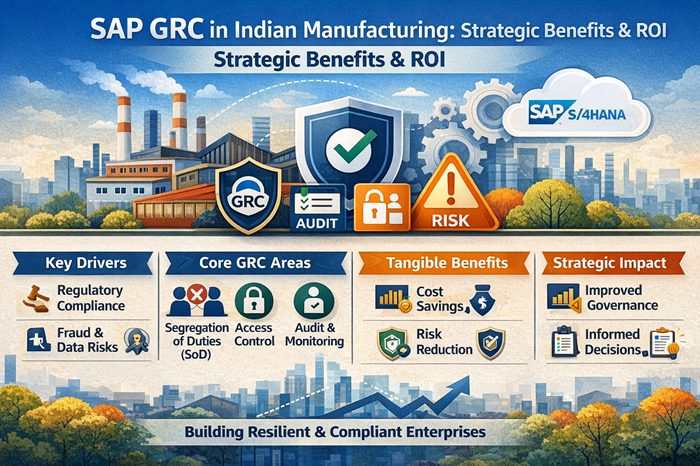
2. Why GRC Adoption is Accelerating
Indian manufacturing enterprises—particularly in sectors such as automotive, FMCG, and metals—are confronted with a unique combination of challenges:
- Increasing regulatory complexity (e.g., GST compliance, internal controls, ESG reporting)
- Distributed and multi-tier supply chains
- Elevated exposure to operational and financial risks
- Rapid digitization of core business processes
Within such an environment, SAP systems serve as the transactional backbone. However, without an embedded control mechanism, these systems can also become sources of risk. SAP GRC provides a structured approach to mitigate these vulnerabilities by integrating governance directly into business processes.
3. Functional Capabilities of SAP GRC
From a systems perspective, SAP GRC enables organizations to institutionalize control mechanisms through:
- Segregation of Duties (SoD): Ensuring that critical business functions are not concentrated within a single role, thereby reducing fraud risk
- Access Risk Management: Enforcing least-privilege access principles across enterprise systems
- Process Control & Audit Automation: Transitioning from periodic, manual audits to continuous monitoring frameworks
- Third-Party Risk Management: Extending compliance controls to vendors and supply chain partners
These capabilities collectively transform GRC from a reactive audit tool into a proactive risk management system.
4. Empirical Indicators of Business Impact
Empirical observations from industry implementations indicate that SAP GRC adoption can lead to:
- Significant reduction in SoD conflicts within a short implementation window
- Enhanced visibility into user access risks and system vulnerabilities
- Reduction in manual audit effort and associated operational overheads
- Improved standardization of access provisioning and control workflows
While the exact magnitude of impact varies across organizations, the directional benefits remain consistent.
5. Deconstructing ROI: A Multi-Dimensional Perspective
The return on investment (ROI) from SAP GRC should not be viewed solely through a cost-saving lens. Instead, it must be evaluated across multiple dimensions:
a) Direct Cost Efficiencies
- Reduction in audit and compliance-related expenditures
- Lower administrative overhead in user access management
b) Risk Mitigation
- Prevention of fraud, financial misstatements, and data breaches
- Avoidance of regulatory penalties and reputational damage
c) Operational Efficiency
- Automation of approval workflows
- Reduced dependency on manual intervention and IT support
d) Strategic Enablement
- Real-time risk visibility for informed decision-making
- Stronger governance frameworks to support business scaling
In many cases, the most significant value arises not from cost savings, but from risk avoidance and improved decision quality.
6. Organizational and Implementation Challenges
Despite its advantages, GRC adoption is often constrained by:
- Limited alignment between business processes and control frameworks
- Over-engineering of roles and authorizations
- Resistance to change within operational teams
- Misconception of GRC as a compliance overhead rather than a strategic enabler
Addressing these challenges requires not only technical implementation, but also organizational change management and leadership commitment.